The Xenomorph. Just hearing the name evokes a shiver for many, bringing to mind the acid-blooded, inner-jawed terror that has stalked humanity across the stars for over four decades. From the claustrophobic dread of a lone space freighter to epic battles with colonial marines, The Alien Movie Franchise: In-Universe Chronological Order offers a sprawling, often terrifying, narrative tapestry. But understanding exactly when each film, and now TV series, unfolds can feel like navigating a derelict spacecraft—confusing, dark, and full of hidden threats.
If you’ve ever found yourself asking whether to watch Prometheus before Alien, or where Alien vs. Predator fits in (spoiler: it mostly doesn't), you're not alone. This guide is your definitive flight recorder, designed to help you piece together the terrifying saga of the Xenomorph from its mysterious origins to its grim future, ensuring you experience the story exactly as it happens in the fictional universe.
At a Glance: Your Guide to the Alien Timeline
- Chronological Isn't Release: The films weren't released in the order their stories take place. Prequels and interquels arrived much later.
- Two Main Canons: There's the primary Alien saga (Ripley's story, prequels, Romulus) and the largely separate Alien vs. Predator crossover films.
- Prequels Set the Stage: Prometheus and Alien: Covenant explore the chilling origins of humanity and the Xenomorphs.
- Ripley's Enduring Saga: The original four films follow Ellen Ripley's harrowing journey through multiple encounters.
- New Horizons: Upcoming entries like Alien: Romulus and Alien: Earth deepen the lore and fill gaps in the established timeline.
- Watching Options: For first-timers, release order often offers the best experience. For lore enthusiasts, chronological order unlocks new insights.
The Enduring Allure of the Alien Franchise
What began as a single, groundbreaking sci-fi horror film by Ridley Scott in 1979 has blossomed into one of cinema's most iconic and influential franchises. Known for H.R. Giger's hauntingly biomechanical creature design, its unflinching portrayal of terror, and a continuous exploration of corporate greed and existential dread, the Alien saga transcends simple monster movies. It delves into themes of creation, evolution, artificial intelligence, and what it means to be human in the face of an utterly alien horror.
Over the decades, the franchise has expanded beyond film into comics, video games, novels, and now television. This expansion, while enriching the universe, has also introduced complexities, particularly when it comes to maintaining a consistent timeline. Understanding the Alien movie franchise in-universe chronological order isn't just about watching films in sequence; it's about appreciating the evolving narrative, the subtle connections, and the overarching story of humanity's perilous dance with its creators and destroyers.
Untangling the Threads: Canon and Contradictions
Before we dive into the chronological specifics, it's crucial to address the concept of "canon" within the Alien universe. Like many long-running franchises, the line between what's officially "part of the story" and what's considered an alternate take or expanded universe material can be blurry.
The primary Alien film series, encompassing the original four Ripley films, Prometheus, Alien: Covenant, and the upcoming Alien: Romulus and Alien: Earth TV series, generally forms a cohesive, if occasionally retconned, narrative.
Then there are the Alien vs. Predator films. While popular, these crossovers largely sit outside the main Alien canon due to significant chronological contradictions introduced by the Prometheus and Covenant prequels. Think of them as fun, self-contained adventures in a separate continuity that borrows elements from both worlds. We'll include them here for completeness, but with a clear disclaimer.
The Complete Alien Movie Franchise: In-Universe Chronological Order
Strap in. This is where we journey through the harrowing timeline of the Alien universe, from ancient encounters to future nightmares.
1. Alien vs. Predator (2004)
- In-Universe Date: October 2004
- Key Event: Weyland Corporation (yes, that Weyland) discovers a mysterious heat signature beneath the ice of Bouvetøya Island, Antarctica. A research team, led by Lex Woods, finds an ancient pyramid where Predators have been using Xenomorphs as a coming-of-age hunting ritual for millennia.
- Significance: This film introduces the crossover concept and features a younger Charles Bishop Weyland (portrayed by Lance Henriksen, who famously played the android Bishop in Aliens and Alien 3). However, its setting in 2004, and the implication of ancient Xenomorph presence on Earth, directly clashes with the timeline established by Prometheus and Alien: Covenant, which depict the Xenomorph's creation much later.
- Canon Status: Largely considered non-canon to the main Alien film series.
2. Alien vs. Predator: Requiem (2004)
- In-Universe Date: Immediately after Alien vs. Predator, late 2004
- Key Event: A direct sequel, this film sees a Predalien (a Predator/Xenomorph hybrid) crash-landing in Gunnison, Colorado. It quickly overruns the small town, leading to a brutal cleanup effort by a lone Predator and a group of human survivors.
- Significance: Continues the crossover narrative. It also suggests that Predator technology eventually fell into human hands, particularly influencing the development of the Yutani Corporation, which would later merge with Weyland to form Weyland-Yutani.
- Canon Status: Also considered non-canon, for the same reasons as its predecessor.
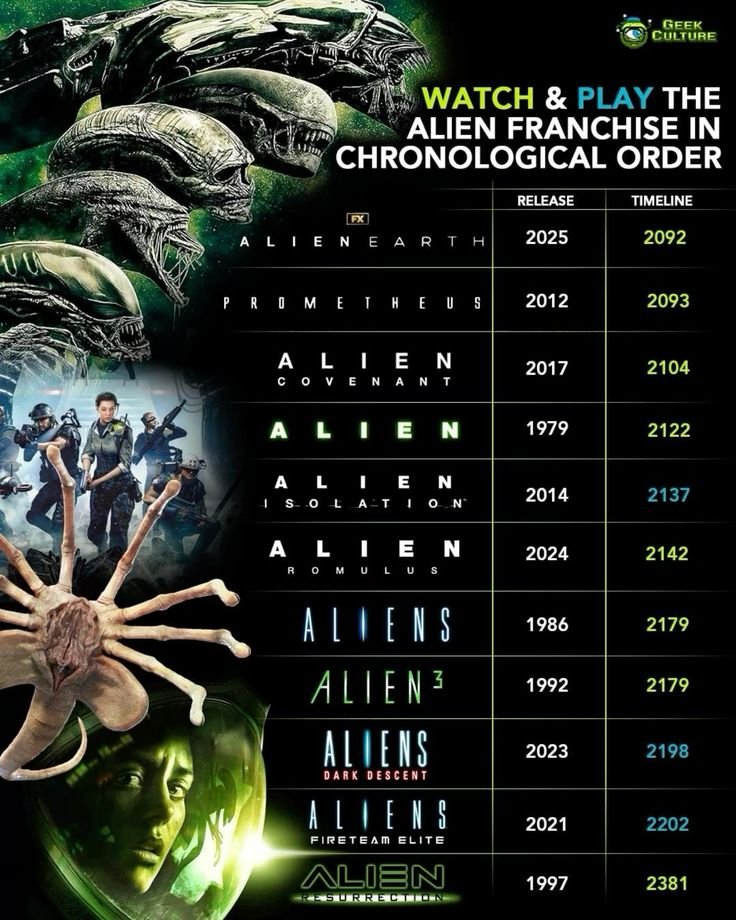
3. Prometheus (2089-2093)
- In-Universe Date: December 2089 - January 2093
- Key Event: A scientific expedition funded by the dying Peter Weyland travels to the distant moon LV-223 in the Zeta II Reticuli system, following a star map found in various ancient cultures on Earth. Their goal: to find humanity's "Engineers" (our creators). What they discover instead is a derelict bioweapons facility, a horrifying black pathogen, and a series of monstrous alien lifeforms, including the nascent form of a Xenomorph-like creature (the Deacon).
- Significance: This film is a foundational prequel, introducing the Engineers, the black goo mutagen, and the android David. It explicitly begins the journey to explain the origins of the Xenomorph and humanity itself, setting a philosophical tone distinct from the original Alien's pure horror. It was initially conceived as a direct prequel to Alien.
4. Alien: Covenant (2104)
- In-Universe Date: December 2104 (11 years after Prometheus)
- Key Event: The colonizer ship Covenant, en route to a new world, intercepts a mysterious transmission and diverts to an uncharted planet. There, they encounter David, the android survivor from Prometheus, who has been conducting horrific experiments with the black pathogen, creating new alien species like the Neomorphs, and ultimately perfecting the Xenomorph. The film ends with David infiltrating the Covenant with two facehugger embryos.
- Significance: This is where the Xenomorph's origin story truly takes shape, squarely placing David as its primary creator. It directly bridges the gap between the creatures seen in Prometheus and the classic Xenomorph, doubling down on themes of flawed creation and playing God.
5. Alien: Earth (TV Series) (2120)
- In-Universe Date: ~2120 (Two years before Alien)
- Key Event: Set on Earth, this upcoming TV series focuses on a tactical team investigating a crashed alien spacecraft. It promises to explore corporate espionage and class conflict within the looming shadow of the Weyland-Yutani Corporation.
- Significance: This will be the first live-action Alien story set primarily on Earth, offering a fresh perspective on the franchise's themes and potentially detailing how knowledge of alien life begins to filter into human society, perhaps even leading up to the Nostromo's fateful mission. This series adds another crucial piece to the Alien Movie Franchise: In-Universe Chronological Order.
6. Alien (2122)
- In-Universe Date: June 2122
- Key Event: The commercial towing vessel Nostromo is diverted to investigate a distress signal on the seemingly barren planetoid LV-426. The crew unknowingly brings aboard a terrifying, parasitic creature—the Xenomorph. Warrant Officer Ellen Ripley's harrowing fight for survival introduces the full life cycle of the creature, from egg to facehugger to chestburster to fully grown warrior. The film famously highlights corporate indifference with "Special Order 937: Crew expendable."
- Significance: The film that started it all. It established the iconic creature, the oppressive atmosphere, and Ellen Ripley as one of cinema's most enduring heroines. This is where the universe truly "begins" for many fans, making it a critical point in the Order of Alien and Predator films.
7. Alien: Romulus (~2142)
- In-Universe Date: ~2142 (Approximately 20 years after Alien, and 37 years before Aliens)
- Key Event: A new cast of young scavengers on a derelict Weyland-Yutani research station stumble upon Xenomorphs, leading to a desperate fight for survival. The film promises to directly connect to the original Alien, including aspects of the android Ash.
- Significance: This interquel fills a significant gap between Alien and Aliens, exploring new characters' encounters with the creature without Ellen Ripley. It's a fresh take, directed by Fede Álvarez, aiming to capture the original film's horror while expanding the main timeline. Its placement is vital for a complete understanding of the Alien Movie Franchise: In-Universe Chronological Order.
8. Aliens (2179)
- In-Universe Date: March 2179 (57 years after Alien)
- Key Event: Rescued from 57 years in hypersleep, Ellen Ripley returns to LV-426 (now known as Acheron) with a unit of Colonial Marines after contact is lost with a terraforming colony established there. They discover a full-blown Xenomorph hive, complete with a terrifying Xenomorph Queen. The film blends sci-fi horror with intense action, further exposing Weyland-Yutani's insidious schemes to weaponize the creatures.
- Significance: James Cameron's action-packed sequel redefined the franchise, expanding the Xenomorph lore with the introduction of the Queen and the hive mentality. It solidified Ripley's role as a warrior and introduced fan-favorite characters like Newt and Hicks.
9. Alien 3 (2179)
- In-Universe Date: Immediately after Aliens, late March 2179
- Key Event: Ripley's escape pod crashes on Fiorina "Fury" 161, a desolate maximum-security prison planet inhabited by male convicts. She discovers she's the sole survivor of the crash, and an alien creature (a "Runner" Xenomorph, born from an animal host) is loose on the facility. In a devastating twist, Ripley learns she carries a Queen embryo inside her, leading to her ultimate sacrifice to prevent Weyland-Yutani from acquiring the creature.
- Significance: A bleak, philosophical continuation of Ripley's story, Alien 3 brought her arc to a tragic, heroic close. It reinforced the terrifying resilience of the Xenomorph and the unyielding greed of the corporation.
10. Alien: Resurrection (2381)
- In-Universe Date: 2381 (Over 200 years after Alien 3)
- Key Event: On board the military research vessel USM Auriga, scientists genetically engineer Ellen Ripley from her blood samples, inadvertently cloning a Xenomorph Queen inside her as well. The resulting "Ripley 8" is a human-Xenomorph hybrid with enhanced strength and acid-resistant blood. When the Xenomorphs escape, Ripley and a crew of space pirates must fight for survival as the ship heads for Earth. The film culminates in the birth of the "Newborn," a grotesque human-Xenomorph hybrid.
- Significance: This film offered a bizarre, albeit visually distinct, continuation of the franchise, pushing the boundaries of human-alien hybrid themes. It effectively marks the end of Ellen Ripley's traditional journey, albeit through a cloned iteration.
The Alien Multiverse: What's Canon, What's Not?
While our focus here is primarily on the films and official TV series, the Alien universe extends far beyond. Comics, novels, and video games have woven intricate tales, sometimes aligning with, and sometimes diverging from, the main cinematic timeline.
For instance, the Dark Horse comics, for a long time, served as a de facto continuation of Ripley's story after Aliens, long before Alien 3 and Resurrection were made. Games like Alien: Isolation (set between Alien and Aliens) are often lauded for their faithful adherence to the original film's tone and aesthetic, making them feel very much "canon" in spirit, even if not explicitly referenced in the films.
The key takeaway is that the "main" film canon, particularly from Prometheus onwards, has taken precedence. If a tie-in contradicts these films, it's generally relegated to a separate continuity. This approach allows filmmakers flexibility while giving fans a primary narrative to follow.
How to Watch: Chronological vs. Release Order
Now that you know the Alien Movie Franchise: In-Universe Chronological Order, the big question is: how should you watch them?
For First-Time Viewers: Release Order is King
If you're new to the franchise, we strongly recommend watching the films in their original release order:
- Alien (1979)
- Aliens (1986)
- Alien 3 (1992)
- Alien: Resurrection (1997)
- Alien vs. Predator (2004)
- AVP: Requiem (2007)
- Prometheus (2012)
- Alien: Covenant (2017)
- Alien: Romulus (2024 - once released)
- Alien: Earth (TBD - once released)
Why release order?
- Appreciate the Evolution: You'll experience the shifts in tone and style as intended by the filmmakers, from Scott's horror to Cameron's action and beyond.
- Preserve Reveals: The prequels, Prometheus and Covenant, were designed to answer questions raised by Alien. Watching Alien first allows those questions to naturally arise before their answers are explored.
- Impact of Prequels: The retcons and additions in the prequels have a greater impact when you understand what they're retconning or adding to.
- The AVP Distraction: Watching the AVP films early in the release order allows you to enjoy them as a separate entity without the immediate burden of canonical contradictions that might arise if you tried to fit them into the main Alien timeline chronologically. Understanding the Order of Alien and Predator films by their release date can clarify why the crossovers exist.
For Seasoned Fans and Lore Enthusiasts: Chronological Order Deep Dive
If you've already experienced the franchise multiple times and want to delve deeper into the narrative's flow, the in-universe chronological order can offer a fascinating new perspective:
- Alien vs. Predator (Optional, with non-canon understanding)
- AVP: Requiem (Optional, with non-canon understanding)
- Prometheus
- Alien: Covenant
- Alien: Earth (TV Series, once available)
- Alien
- Alien: Romulus (once available)
- Aliens
- Alien 3
- Alien: Resurrection
Why chronological order?
- Uncover the Lore: This order allows you to trace the Xenomorph's origins and evolution from its earliest, mysterious forms to its perfected state.
- Continuous Narrative: You'll experience the story as a continuous, unfolding history of humanity's encounters with these deadly creatures and the motivations behind Weyland-Yutani.
- New Connections: You might spot subtle details and connections you missed when watching in release order, deepening your appreciation for the world-building.
The Future of Fear: What's Next for the Alien Franchise?
The Alien franchise is far from dormant. The upcoming Alien: Romulus is generating significant buzz for its return to the gritty horror roots and its prime placement within the main timeline. Director Fede Álvarez is already set to explore potential sequels, indicating a renewed commitment to expanding the cinematic universe.
Furthermore, the Alien: Earth TV series on FX and Hulu promises to offer a new perspective, taking the horror to Earth itself. There's even talk of a potential new Alien vs. Predator crossover, with Álvarez expressing interest in co-directing with Prey director Dan Trachtenberg. This indicates a potential revitalization of the crossover concept, perhaps with a fresh approach to its canonical standing. The future looks both terrifying and exciting for fans of the ultimate organism.
Common Questions About the Alien Timeline
Are the Alien vs. Predator movies canon?
Generally, no. While they are fun crossovers, their plot points (especially the ancient presence of Xenomorphs on Earth) contradict the origins established in Prometheus and Alien: Covenant. Most fans and filmmakers consider them to exist in their own separate continuity.
Where does Alien: Romulus fit in the timeline?
Alien: Romulus is an interquel, set approximately 20 years after the events of the original Alien (2122) and 37 years before Aliens (2179). It fills a significant gap in the main Ripley-less timeline.
Do I need to watch Prometheus and Alien: Covenant to understand Alien?
No, Alien stands perfectly on its own as a masterpiece of horror. Prometheus and Covenant are prequels that expand on the origins of the Engineers and the Xenomorph, adding layers to the lore, but they aren't essential for understanding the original film's immediate narrative.
Is Alien: Earth a movie or a TV series?
Alien: Earth is an upcoming TV series for FX and Hulu, set on Earth, a couple of years before the events of Alien.
What about all the Alien video games and comics? Are they canon?
Many games and comics are considered "expanded universe" material. Some, like Alien: Isolation, are widely praised for fitting seamlessly into the main film timeline's tone and events (set between Alien and Aliens). Others exist in their own continuities. The film series, especially the prequels, generally takes precedence when contradictions arise.
Your Journey Through Terror Begins
Whether you choose to embark on this journey in release order to appreciate its historical evolution or plunge straight into the Alien movie franchise in-universe chronological order to connect the dots of its terrifying lore, one thing is certain: you're in for a visceral, thought-provoking, and utterly horrifying ride.
The Alien franchise continues to be a benchmark for sci-fi horror, proving that some fears are timeless. So, dim the lights, check your airlock, and prepare to face the ultimate organism. Just remember: in space, no one can hear you scream.